
Your Information Has a Clarity Score You Cannot See
When a procurement manager at a food processing plant asks ChatGPT for “sanitary pump manufacturers that meet 3-A Sanitary Standards,” the AI system does not pick winners at random. It runs a process. It evaluates information. And it does that evaluation using criteria that most manufacturers have never heard of.
We call those criteria the Clarity Index. Eight weighted factors produce a single score. If any one of them is weak, your overall Clarity score drops. If any one of them is at the floor, you can be excluded entirely from the answer. AI systems do not tell you this is happening. They just stop recommending you.
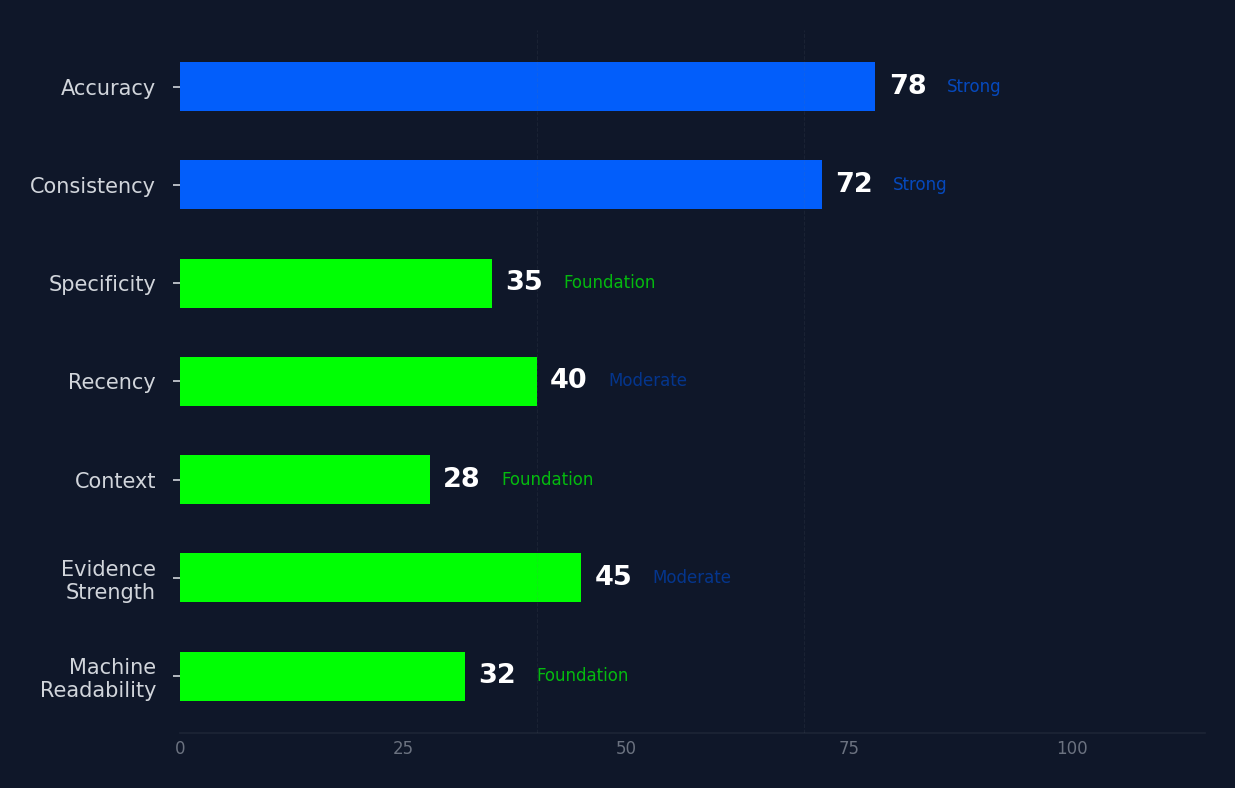
Here are the eight factors in plain language, with a manufacturing example for each.
1. Accuracy: Your Claims Must Match External Sources
Accuracy asks whether the claims on your website, in your business listings, and across your digital presence match what external sources can verify.
Consider a custom metal fabrication shop in Michigan. Their website says they are ISO 9001:2015 certified. Their LinkedIn company page says the same. But the official ISO register shows their certification lapsed fourteen months ago. Google Business Profile still lists the old cert number. A distributor directory references the certification in a product listing.
When an AI system cross-references this company’s claims, it finds a contradiction. The ISO register says one thing. The company’s own properties say another. The system does not know which to trust, so it lowers the confidence score. In borderline cases, it simply omits the company from recommendations rather than risk citing incorrect data.
Accuracy problems compound because they do not live in one place. They spread across platforms, get scraped into databases, and persist long after you have corrected the source. The fix is systematic: audit every verifiable claim against authoritative external sources, then correct the discrepancies everywhere they appear.
2. Consistency: Your Data Must Say the Same Thing Everywhere
Consistency checks whether your data aligns across every platform where it appears. Not “close enough.” Identical where it needs to be.
Take a contract manufacturer that builds cable assemblies. Their website lists their address as “4500 Industrial Parkway, Building C.” Their Google Business Profile says “4500 Industrial Pkwy, Ste C.” Their ThomasNet listing says “4500 Industrial Parkway, Suite C, Building 4.” Their Dun and Bradstreet record has a slightly different phone number.
To a human scanning a directory listing, these look like the same company. To an AI system, they look like conflicting records. The system has to decide whether these references point to one entity or multiple. Ambiguity reduces confidence. Reduced confidence reduces the probability of inclusion in a recommendation.
This is not about being pedantic. It is about understanding how machines evaluate information. They do not read like humans. They parse. They compare. They look for exact matches. Every inconsistency is a small vote against your reliability.
3. Specificity: Your Content Must Be Precise Enough to Cite
Specificity determines whether your content contains facts a machine can use with confidence. AI systems need concrete details they can repeat in an answer. Vague marketing language gives them nothing.
A hydraulic cylinder manufacturer writes on their homepage: “We deliver reliable performance for demanding applications.” An AI system reading that extracts no usable fact. It cannot cite “reliable performance” because it means nothing specific.
Compare that to: “Our hydraulic cylinders operate at pressures up to 10,000 PSI, with bore sizes from 1.5 to 24 inches, available in both tie-rod and welded configurations, with standard lead times of six to eight weeks.” That is a sentence full of facts a machine can extract, verify, and cite. It is specific enough to anchor a recommendation.
In our diagnostic work, specificity is the most common failure point. Most companies have zero specific evidence markers on their core pages. No percentages, no performance data, no named customer outcomes. By Google’s own definition, that content is commodity.
Every page on your site should contain at least one sentence that specific. If a machine cannot pull a concrete fact from a page, that page is effectively invisible to Answer Architecture. It passes through the extraction gate but has nothing to offer at the correlation or synthesis gates.
4. Recency: Stale Data Gets Deprioritized as Unreliable
AI systems treat freshness as a reliability signal. Outdated information is more likely to be wrong, so stale data gets deprioritized. Recency checks how current your information is across the board.
A precision machining company has a “Capabilities” page last updated in 2019. The equipment list includes machines they sold during the 2020 downturn. The certifications section references a revision of AS9100 that was superseded two years ago. Their case studies are all from 2017 and 2018.
When an AI system evaluates this company against a competitor whose case studies run through 2025, whose equipment list was updated last quarter, and whose certifications reference current revisions, the freshness signal favors the competitor. Everything else being equal, the system recommends the company with current information. It is not a preference for newness. It is a reliability calculation.
Recency is not about churning content for the sake of it. It is about making sure the information machines use to evaluate you reflects reality today, not reality four years ago.
5. Context: Isolated Data Points Get Lower Clarity Scores
Context measures how well your information connects to verified external facts. AI systems do not just read your website. They traverse a knowledge graph that links companies, people, products, certifications, and industry classifications. If your company exists as an isolated node with few connections, the system has trouble finding you through the paths it actually uses.
A manufacturer of industrial ovens for powder coating has no Wikidata entry. No verified Google Knowledge Panel. Their website schema does not include sameAs links to LinkedIn, ThomasNet, or their industry association profile. Their Dun and Bradstreet number does not appear anywhere in their structured data.
A competitor with identical capabilities has all of these connections. When an AI system processes a query about powder coating ovens, it finds the competitor through multiple paths in the graph and finds our manufacturer through exactly one: their website. The system rates the competitor as better connected and therefore more trustworthy, even if the underlying capabilities are the same.
Context is the factor most companies ignore because it feels technical and abstract. It is not abstract at all. It is the digital equivalent of having your name, address, and credentials filed correctly at every relevant institution. If the machines cannot find you through the graph, they cannot trust you through the answer.
6. Machine Readability: Can AI Parse Your Content?
Machine Readability evaluates whether your content is structured in a way AI systems can parse efficiently. Think of it as the difference between handing someone a neatly organized binder and handing them a stack of loose papers. Both contain the same information. One is usable immediately. The other takes effort.
A manufacturer of industrial valves has product specifications buried in PDF datasheets that are linked from product pages but not embedded in the page HTML. Their homepage has no Organization schema. Their product pages lack structured data entirely. Headings are styled with CSS font sizes rather than proper H1, H2, and H3 tags. A human visiting the site sees a professional layout. An AI system fetching the page sees a wall of unstructured text with no semantic markers.
The competitor has JSON-LD schema on every product page specifying product name, specifications, materials, and certifications. Their headings follow a clean hierarchy. Their images have descriptive alt text. A machine can extract structured facts without guessing what is a product name and what is a navigation label.
Machine Readability is the factor where small technical changes produce outsized results. Adding Organization schema to your homepage takes thirty minutes. It is the single most impactful fix most companies have not made.
7. Rendering Independence: Does Your Content Exist Without JavaScript?
Rendering Independence is binary. Either your content is in the raw HTML the server sends, or it requires JavaScript to appear. AI crawlers like GPTBot and ClaudeBot make raw HTTP requests. They do not execute JavaScript. If your content is loaded dynamically through JavaScript frameworks, AI systems never see it.
A manufacturer rebuilt their website using a modern JavaScript framework. The product catalog looks excellent in a browser. Product names, specifications, pricing, and availability all render perfectly. But when a crawler fetches the page, it receives a nearly empty HTML document with a JavaScript bundle reference. The crawler moves on. The entire product catalog is invisible to AI.
This is the most expensive failure mode in the Clarity Index because the company invested heavily in content that AI literally cannot access. The information is there. The machine cannot see it. The fix is server-side rendering or static generation, which ensures content exists in the HTML response before any JavaScript runs.
If you are not sure whether your site has this problem, view your page source in a browser. If the product names and specifications are not in the raw HTML, neither is anything else AI needs.
8. Hallucination Risk: Will AI Make Things Up About You?
Hallucination Risk measures the probability that an AI system fabricates incorrect information about your company when it cannot find enough verified data. When your information ecosystem has gaps, contradictions, or missing context, AI systems fill those gaps with plausible-sounding guesses. Those guesses become what buyers believe about you.
Consider a specialty alloys manufacturer that does not publish their material certifications online. An AI system trying to describe the company knows they make nickel-based alloys. It knows they serve aerospace. But it cannot verify which specific grades they carry, what certifications they hold, or which standards they meet. So it guesses. It lists the most common grades for aerospace alloys. It attributes certifications the company does not actually hold. The description sounds authoritative. It is completely wrong.
The lower your other factor scores, the higher your Hallucination Risk. Missing data creates the gap. Inconsistent data widens it. The AI does not know it is guessing. It treats the fabricated information with the same confidence as verified facts, and it passes that confidence to the buyer.
The fix is coverage. Every claim a buyer would research should have corresponding content on your site with enough specificity that the AI never needs to fill in blanks. If the AI can find the answer, it will not invent one.
How the Eight Factors Work Together
These eight factors produce your Clarity Index through a weighted average. Each factor is scored from 1 to 5. The factors carry different weights based on how much they influence AI trust: Context at 20%, Accuracy at 17%, Consistency and Specificity at 15% each, Recency at 12%, Machine Readability at 8%, Hallucination Risk at 7%, and Rendering Independence at 6%.
A floor rule applies. If any single factor scores a 1, the composite score is capped at 70 regardless of how strong the other factors are. A total blind spot in one area prevents the overall score from reaching “Strong.” This reflects how AI systems actually work: a single category of failure can trigger enough distrust to exclude the company entirely.
Most manufacturers we work with are strong on Accuracy and Consistency (once they have cleaned up the obvious problems) and weak on Specificity, Recency, and Context. They have correct data that is too vague, too old, and too disconnected. Fixing those factors typically produces the biggest improvement in Coverage. It is not about being perfect everywhere. It is about eliminating the weakest link in the chain.
This is one part of a broader AI readiness assessment. The diagnostic is not complicated. Score yourself on all eight factors, find the weakest one, and fix it first. That is where your pipeline is leaking.




Find Out What AI Tells Buyers About You
An AI visits your site and reports everything it found. Scored across six categories with machine-verifiable findings. No cost, no pitch.
Get Your Free Snapshot